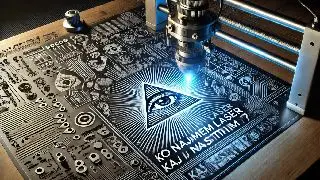
Instructions for use of CNF 160 for UV CO2 FIBER marker laser
Instructions for use of CNF 160 for UV CO2 FIBER marker laser
When a small company develops a new product, time is precious. Even more valuable is repeatability. This is why good knowledge of CNF 160 is one of those small advantages that make a big difference in practice. Such a system is designed to prepare and manage laser marking, where you want to quickly create text, series, logos, codes and other markings without wasting any time. This logic is particularly familiar with flying markings, since CNF 160 is intended for continuous marking on the line, and the software design includes settings for marking parameters, production line, optical size, laser, marking mode, date and time and user management.
CNF 160 program for laser and first steps of launch
For a successful start it is most important to open the software environment calmly and in the same order. First connect the computer to the device, check the control panel driver, run the software and open a new file to prepare the content. Similar installation instructions for such laser systems emphasize precisely the identification of the control panel and the correct location of the driver, since without this there is no stable communication between the software and the laser.
- switching on machine and computer connection
- driver or control panel checks
- start of CNF 160
- creating a new mark file
- text, logo, batch or code entry
- saving work file for later re-use
This approach is very useful for small development teams, because once prepared the template can only be adapted later to a new product. Instead of starting over each time, upgrade an existing file and prepare a new series within minutes.
CNF 160 marking settings for UV CO2 and FIBER laser
The core of CNF 160 is the settings menu. Related CNF instructions clearly indicate that the settings can be edited Marking Parameter, Production Line, Optical Size, Laser, Marking Mode, Date Time, User Management, Access Management and system data. This means that the program is designed not only to draw content but also to actually adapt the machine to process and material.
- marking speed
- laser power
- frequency
- length pulse or pulse length
- laser he works
- laser off worky
- mark delay
- poly labour
- jump work
A simple rule applies to these settings. Higher speed isn't always better. The guidance for the related CNF system indicates that the marking rate is given in mm per second and must be coordinated with power and frequency. If the speed is too high, the contrast may be too low. If the power is too high, you can make too deep or too wide a record on sensitive material.
How to prepare text, logo, batch and code in CNF 160
The usefulness of such software is greatest where the product is often changed. This is the typical reality of small entrepreneurs, innovators and development workshops. Today you test the housing, tomorrow the packaging, the next prototype of the new electronic panel. The CNF and related EZCAD software logic is popular precisely because it allows for relatively quick drafting, graphics, bar codes, serial numbers and other variable content. EZCAD is one of the most widely used platforms in laser labelling, especially known for its support for graphics, barcodes, serial numbers and other variable content.
- add plain text for product name
- entry of the serial number for traceability
- batch or lot number marking
- use of date and time for production needs
- import of logo or vector graphics
- preparation of code for faster product identification
This is important for the development of new products because they can create the appearance of almost the finished product at the testing stage. Laser doesn't just serve labelling. It also often serves to confirm that the idea is ready for the market.
Benefits of CNF 160 in product development and innovation
Entrepreneurs developing new products usually lack the luxury of large teams and long deadlines. They need a simple workflow. In the case of CNF 160, the emphasis is on continuous labelling of products on the production line, with the system supporting the labelling of text, logos, batch codes and similar data. This is very useful in small series, test production and fast iterations.
- faster preparation of prototypes
- easier traceability of batches and development versions
- less errors in manual labelling
- more professional look of the product
- simpler repetition of successful settings
- easier switching between different materials and formats
Once you set the parameters well, you don't just buy a machine. You're buying peace. This is often more valuable for small development teams than hardware itself.
The most common problems with the use of CNF 160 and how to solve them
Most problems are not complicated, but they are annoying. That is why it is beneficial that you have a clear overview of what to check first.
- laser indicates too pale - reduce speed or check power and frequency
- label is too deep - reduce power or correct focus
- content not properly aligned - check workspace and optical size
- program does not communicate with machine - check driver and connection to control panel
- different materials give different results - prepare separate setting templates for each material
- serial production is not uniform - save the verified file and do not change parameters without testing
We make the biggest mistake when we quickly change several parameters at once. It is much wiser to change one setting by one and record the result as you go along. Thus, the company creates its own knowledge library, which is often more valuable than the manual itself.
UV CO2 FIBER laser and choice of the right way to label
Different laser sources are not intended for the same material. EZCAD and related platforms are used for fibre, UV and CO2 marking, where fibre systems are particularly suitable for metals and many technical materials, UV for sensitive materials with low thermal impact, and CO2 for paper, wood, glass, plastics and other organic or non-metallic materials. That is why it is important that you not only think about graphics in the program but also about material, speed and the goal of labelling.
- fiber for metals and durable industrial labels
- UV for fine labels on sensitive materials
- CO2 for packaging, paper, wood and a number of non-metallic surfaces
For an innovator, that means one very practical thing. The same graphics does not mean the same settings. CNF 160 is useful when you understand the connection between the file, laser and material.
CNF 160 user experience in small series development
In developing a new product we wanted to quickly mark prototypes and then without further design the first little series. Once we understood the logic of CNF 160, we prepared several proposals for different materials. The work has become calmer, faster and more predictable. What helped us most was that we were able to store the verified settings for each product and just open them next time. So we made a more professional impression on the buyer and saved ourselves a lot of experiments.
Such an experience is particularly close to small businesses, where the same person often leads development, production preparation and contact with the client. When the program works predictablely, decision making is also easier. And when decision making is easier, development is faster.
CNF programme 160 to help small business grow
Well prepared instructions for the use of the CNF programme 160 it's not just a technical supplement. They are part of business efficiency. When you can quickly open a file, edit parameters, prepare text, save a template and repeat a successful result, the stress on each new series decreases. This is exactly what small innovative companies need. Less improvisation, more control, more impression on the buyer. The world of ink can also help with such systems because it understands the real needs of production, not just the theories in the manual.
If you are developing a new product, testing a small series or looking for a way to turn laser labelling into a reliable part of your process, it makes sense that CNF 160 is a thorough and practical program. How much time and nerves would it save your company if you had a check laser template ready for each new product?