What is a capacitor and why are we using it?
What is a capacitor and why are we using it?
The capacitor is a small electronic component that can store electricity for a short period of time and then quickly transmit it back into the circuit. If we imagine the circuit as a water main, the capacitor is similar to a small reservoir. When there's enough power, it fills up. When there is a short drop, a disturbance, or a rapid need for additional energy, it gives it away.
This is why the capacitor is found almost everywhere. In power supplies. In the LED lights. In the engines. In printers. In audio devices. In industrial automation. Even in devices where the user does not even think about electronics, but only expects everything to work reliably.
To whom is this explanation most intended?
The biggest target group are people who encounter electronics practically, not academically. These are repairmen, local masters, students, maintenance workers, buyers of electronic components, manufacturers of devices, modelers and anyone who wants to understand why the device sometimes behaves strangely, why the engine does not run well, why the power supply blinks or why electronics fail just when we need it most.
Their main problem is not a theory. Their problem is uncertainty. Buy what? Which capacitor to select? Why is it marked 470 μF 25 V? What's a super capacitor? Can the wrong choice damage the circuit? And here, understanding capacitors becomes very useful.
A simple summary: what does the capacitor do?
The capacitor stores the electrical charge. It consists of two conductive surfaces, between which is an insulating material called dielectric. When the voltage is connected to the capacitor, one side is charged positively, the other side negative. The energy shall be stored in the electric field between these two surfaces.
In practice, this means something very useful. The capacitor can smooth the voltage, reduce the interference, help start the engine, save a short energy pulse, separate direct and alternate signals and protect sensitive parts of the circuit from rapid changes. Classic capacitors are often used to stabilize power and filter interferences, as they can quickly accept and deliver a charge. They are similarly interpreted by technical sources describing the capacitor as a passive component for storing electric charge between two conductive surfaces.
Why do we use a capacitor in electronics?
Because electronics don't like shocks, noises and instability. Microcontroller, sensor, LED module or engine controller often requires stable voltage. If the voltage drops for a moment, the device can reset. If a malfunction occurs, the circuit can detect the signal incorrectly. If the engine pulls too much current on start-up, the rest of the system may lose its stable power for a moment.
This is where the capacitor acts as a silent assistant. You can't see him. You don't press it. You don't set it every day. But when it's properly selected, the circuit is more calm, more stable and more reliable.
Most common applications of the capacitor
- Voltage cooling in power supplies: after directing the ac voltage, the capacitor helps to reduce the wave and creates a more stable dc voltage.
- Filtering of electrical disturbances: removes short spikes, noise and unwanted rapid voltage changes in circuits.
- Engine starting aid: for some engines, the capacitor creates a phase delay or helps with the initial start-up.
- Short-term energy storage: at the moment when the circuit needs fast additional energy, the capacitor can deliver it very quickly.
- Signal separation: capacitor can block the dc component and transmit the alternating signal, which is useful in audio and communication circuits.
- Circuit protection: helps reduce dangerous voltage surges that may interfere or damage sensitive components.
Example from practice: why is the LED light flashing?
Imagine a small LED device powered by a cheap power supply. Without a good enough capacitor, LED light can flash slightly and electronics are unstable. After adding a properly selected capacitor, the capacitor stores part of the energy and delivers it between short falls of voltage. The result is more peaceful action. Less flashing. Less trouble.
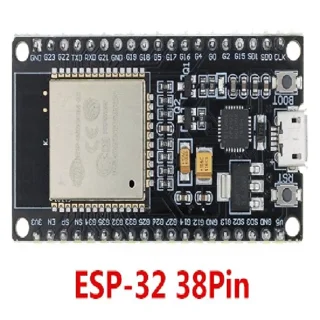
The same applies to microcontrollers such as Arduino, ESP32 or various industrial controllers. When a relay, engine or electromagnetic disturbance is caused, the capacitor can prevent a sudden drop of voltage, thereby reducing the possibility of resetting electronics.
What are the markings on the capacitor?
| Code | Meaning | Why is it important? |
|---|---|---|
| μF, nF, pF | Capacitance | It tells how much electrical charge the capacitor can store. |
| V | Maximum permissible voltage | If exceeded, the capacitor may be damaged or even cracked. |
| Polarity + and - | Connection direction at electrolytic capacitors | The wrong connection can cause damage. |
| Temperature | Allowed temperature range | Important for power supplies, engines and industrial devices. |
| EFF | Capacitor internal resistance | The lower EFF is important for fast current changes and power supplies. |
What's a super capacitor?
Super Capacitor is a special type of capacitor with very high capacitance. While the conventional electrolyte capacitor often has values such as 100 μF, 470 μF or 1000 μF, the super capacitor may have values in the pharaohs. For example 0,22 F, 1 F, 10 F or even thousands of farads in industrial applications.
This means that it can store significantly more energy than a regular capacitor. Still not the same battery. The super capacitor usually fills very quickly, quickly transmits energy and transmits a large number of fillings and discharges. It is therefore interesting where we need a short, strong and reproducible energy impulse.
Super capacitor or battery?
| Property | Super Capacitor | Battery |
|---|---|---|
| Charge speed | Very fast | Slower |
| Power transmission speed | Very High | Normal Lower |
| Number of cycles | Very much | Minor |
| Amount of energy stored | Less than battery | Major |
| Typical use | Short pulses, backup, stabilisation | Long-term power |
Where are the super capacitors used?
- for short-term backup memory or clock supply,
- to assist the starting of devices requiring a strong current pulse,
- in solar and energy fast energy storage systems,
- in industrial automation where short energy shocks occur,
- in IoT devices where we want to extend the reliability of operation,
- in electronics where the battery is not ideal due to slow charging or limited number of cycles.
The user’s psychological problem: fear of wrong choice
When a customer chooses a capacitor, it often buys more than just a component. It buys a sense of security. He wants to know that the circuit board won't fail. Make sure the device doesn't reset. Make sure the engine doesn't interfere. That the power supply won't beep, blink or overheat. And above all, he won't order the wrong job.
Therefore, it is important to think practically when choosing. Capacitance must be fit for purpose. The tension marking shall be sufficiently high. Polarity should be observed for electrolytic capacitors. The EFF is also important for power supplies. For super capacitors, however, we must pay particular attention to the permissible voltage, as individual cells often have low nominal voltage, for example 2,7 V either 3,3 V.
How to choose the right capacitor?
- First, check the purpose: do you want smoothing tension, filtering interference, starting the engine or storing energy?
- Select the correct capacitance: greater capacitance means more stored charge, but not always better for each circuit.
- Always keep an eye on the tension: the capacitor shall have a higher rated voltage than the voltage in the circuit.
- Check the polarity: electrolytic capacitors usually have plus and minus connectors.
- For rapid disturbances use the appropriate type: ceramic capacitors are often very useful for high-frequency rapid disturbances.
- For greater energy consider a superconductor: especially where you need fast charging, quick emptying and a large number of cycles.
Conclusion: small component, great impact
The capacitor is one of those components that is often overlooked until it causes problems. But when we understand his role, it quickly becomes clear why he is so important. It stores electricity. Smooth tension. It reduces interference. It helps the engine. It protects the circuits. It improves reliability.
And the super capacitor goes a step further. It's not a classic battery and it's not just a capacitor. It is a solution for fast energy, a large current pulse and a long life in many cycles. If you want electronics to work more stable, safer and more predictable, the correctly selected capacitor is often a small cost with very high effect.
Does it really make sense to look for an error in the whole device if only one correctly selected capacitor can be the solution?