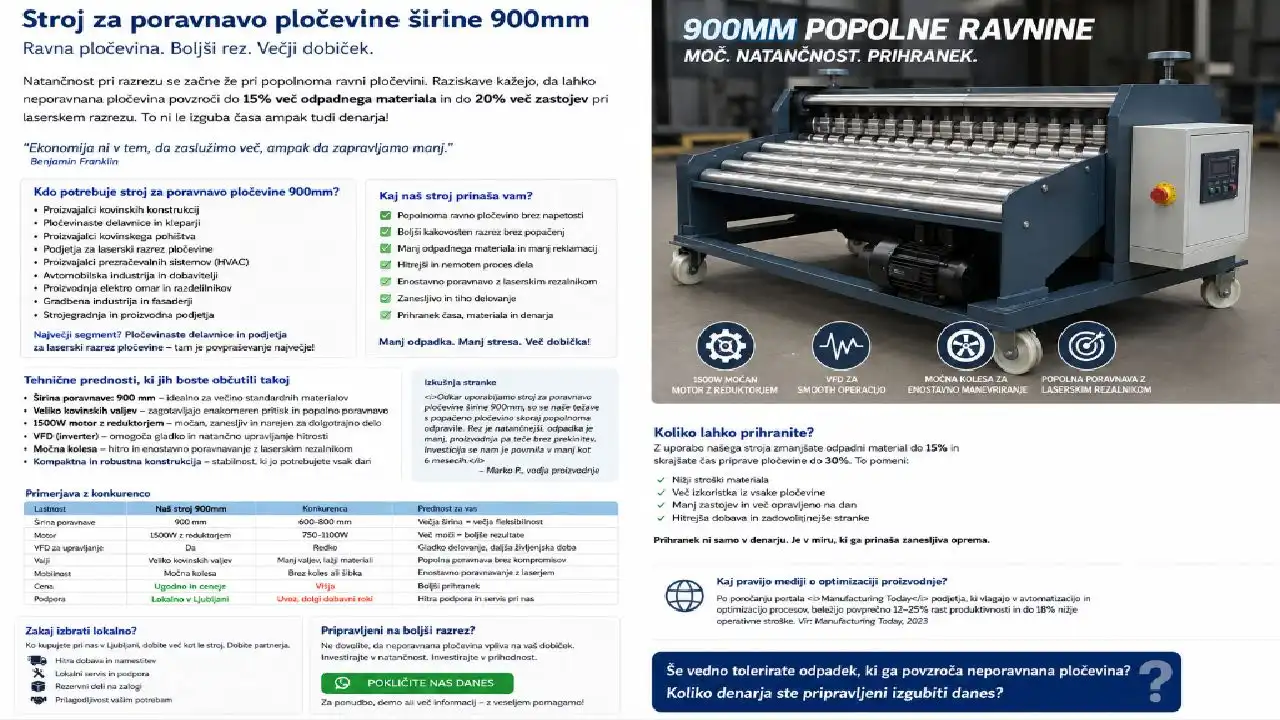
What does the machine look like to perfectly settle the sheet metal before cutting it?
Flat sheeting means more precise cutting, less eject and significantly less problems with further processing. Anyone who has tried laser, plasma, or mechanical cutting of corrugated or curved sheet metal knows how quickly a small deformation can cause a major problem.
The cut is no longer entirely accurate. The material moves during the work. The cut parts are twisted, the edges are not uniform and the components do not fit as they should when welding. The result? Additional handling, slower production, more waste material and unnecessary costs.
This is why it is used before cutting machine for perfect alignment of sheet metal.
What's the metal alignment machine look like?
At first glance sheet straightening machine look like a robust industrial device with a strong metal casing, input table, propulsion system and several successively mounted cylinders.
The most important part of the machine is metal straightening cylinders. These are arranged over and under the sheet. The upper rollers press the material from one side and the lower ones support it and shape it from the opposite side.
The sheet thus changes the direction of bending several times during the passage through the machine. It bends slightly in one direction, then in the other. The procedure is repeated several times, and the bending towards the exit is decreasing. The result is significantly more flat, stable and for further processing of prepared sheet metal.
Why does the straightening machine have so many cylinders?
As a rule, a single pair of cylinders of sheet metal cannot level with sufficient precision. All he can do is squeeze it or give it a rough direction. In the case of quality handling, the material must be processed gradually.
More cylinders mean more controlled bending. Each next cylinder corrects the residual deformation. In this way, the machine can reduce longitudinal curvature, transverse corrugation, raised edges and other irregularities resulting from winding of sheet metal, transport, storage or pre-treatment.
The rollers shall be sufficiently rigid, accurately constructed and properly adjusted. In the case of wider sheet metal, it is also important not to bend under pressure, otherwise alignment in the middle of the material would deviate from the alignment along the edges.
How is the alignment of sheet metal before cutting?
- Place the can on the entry table or place it directly from the reel into the machine.
- The operator sets the thickness of the material, the pressure of the cylinders and the height of the upper assembly.
- Propulsion cylinders pull the sheet metal inside the machine.
- The upper and lower cylinders bend the sheet metal several times.
- The correction towards the exit is becoming smaller and more precise.
- Lined sheet metal prepared for laser, plasma, water or mechanical cutting exits the machine.
The whole process is fast. The correct adjustment does not require manual handling of hammers, presses or improvised procedures, where the result depends heavily on the individual worker’s experience.
What problems are solved by the machine for perfect plate alignment?
The main concern of the user is not usually just whether the sheet metal will look flat. What matters is what happens between the cutting and after.
- The sheet shall not be rocked during cutting: the cutting head is easier to maintain the correct distance from the surface.
- The cut parts are more precise: less deviations in dimensions, angles and position of openings.
- Less ejection: the material does not need to be discarded for twisted or poorly cut pieces.
- Welding faster: the parts are more easily assembled and need less forced clamping.
- The curve is more predictable: the level of material behaves more evenly in the bending machine.
- Production is reproducible: the first, tenth and hundred pieces are much more similar.
Example from production
Imagine a company that makes metal casings for machines. The material before laser cutting is not entirely straight. During cutting, the sheet is raised in certain places, and the individual cut parts change shape after releasing internal tensions.
Workers need to handle each piece further. When assembling the housing, the openings do not match perfectly and the welder uses more time to clamp and adjust.
When involved in production cylinders for sheet metal alignment, the material passes through the upper and lower straightening cylinders before cutting. The sheet enters the cutting machine more flat, the parts fit better, and the need for manual repairs decreases.
The real value is therefore not only in a better piece of sheet metal. Value is saved at each subsequent production step.
Is the machine only suitable for thin sheet metal?
No. No. There are machines for very thin sheet metal, medium thick materials and also stronger industrial versions for thicker plates.
When choosing a machine, it is necessary to know in particular:
- maximum sheet width,
- minimum and maximum material thickness,
- the type of material such as steel, stainless steel or aluminium,
- the strength of the material,
- the required level,
- pass speed,
- the method of connection to the cutting machine or production line.
The softer aluminium machine does not need the same force as the thick or highly solid steel sheeting machine.
How do I know that settlement is good enough?
The most simple test is to place sheet metal on a flat measuring surface. We can check the spread between the sheet metal and the base, the curvature of the edges and any rocking of the material.
In more demanding production, flatness is checked by means of gauges, sensors, laser gauges or automatic surface control systems.
It is also important to check the result after cutting. The material may appear to be flat, but it contains internal tensions which cause the cut-off part to be reshaped after release. Well configured precision sheeting machine thus not only eliminates visual corrugation but also reduces the effect of tension in the material.
What kind of machine do you need?
The most expensive mistake is not the purchase of a slightly more powerful machine. The most expensive error is the choice of a machine that cannot reliably process your material.
Before selecting, I recommend that you prepare samples of the thinest, thickest and most deformed sheet metal you use. On the basis of the actual test we can determine the number of cylinders required, their diameter, power of propulsion, working width and method of adjustment.
We can adapt the machine to your manufacturing process. We take into account the width of the material, the thickness, the speed of the line, the method of feeding and the space at your disposal. If necessary, the system can also be connected to the sheet metal roller, feeder, length measurement or cutting device.
Do not buy a machine solely on the basis of a photograph or maximum thickness stated. Send us information about the material and a photograph of its deformation. Together, we can check what kind of implementation will really bring material level, more accurate cutting and less repair!
Do you want to straighten the sheet before cutting quickly and repeatable?
Contact us and let us know the width, thickness and type of sheet metal. We will prepare a proposal for a sheet metal alignment machine adapted to your working methods.
Less corrugated sheets. Less eject. Better products!