Video
Video v slovenščini
Andrejštajn: AC and DC engines, reducers and VFD
The right engine, reducer and regulator for your machine
Andrejštajn represents AC and DC engines with reduction devices and explains what we can expect from the VFD frequency converter. The presentation is accompanied by a programme of industrial 220 V drives in the range 25-250 W. When choosing a specific product, we use its data, the nominal plate and instructions; the same supply voltage does not necessarily mean the same control mode.
What does AC and DC mean?
AC means alternate power. The tension periodically changes polarity; for network drive, frequency is also important. DC means DC power supply. Small brush DC engines are practical for battery devices, mechanisms and prototypes. BLDC engines and marching engines need their proper control, so we do not choose any regulator for the brush DC engine.
What does the reductor add?
The governor shall reduce the output shaft speed and increase the available torque taking into account losses. It doesn't create any extra power. When selecting for a conveyor belt, a blender or a rotating mechanism, determine the desired speed, permanent and starting torque and the operating cycle. We also consider the permitted radial and axial load of the shaft. The characteristics of the snail transmission did not in itself ensure safe retention of the burden.
How does the VFD work?
VFD is a frequency converter. Input alternating voltage is first converted into a DC in the intermediate circuit and then electronics generate an output AC voltage with adjustable frequency and voltage. In this way we set the speed and course of acceleration or stopping to the appropriate engine. The mode of regulation and the permitted range depend on the engine, converter and load. Interpretation of ABB operations.
Example: Transport line at 50 Hz and 25 Hz
For the same induction engine and the unchanged reduction device, the transition from 50 Hz to 25 Hz is approximately half the speed. The actual speed is also changed by loading and slipping the engine. The slower tape can facilitate dosing, weighing or packaging; the adjustable start ramp reduces the shock of motion. The display in the video is an illustration of the performance, not of the concrete assembly.
What can we expect in slow rotation?
The VFD does not increase the rated engine power. At low speeds we check the permissible permanent torque, current and cooling. The engine fan can rotate slower, so long operation under load requires a specially checked regime. Speed reduction is not a promise that each engine will provide the same power at all settings. For a demanding slow rotation, select the appropriate reducer and a certified range of regulation.
Why does the corresponding three-phase engine not need an additional motor capacitor?
In combination with a suitable VFD with a single phase input of 230 V and a three-phase output of 230 V and an appropriate three-phase engine, the converter creates three phases. The three-phase engine therefore does not require an additional start or work capacitor such as the one-phase engines used to generate the spin field. This does not mean that there are no capacitors in the VFD itself: they are usually part of its intermediate DC circuit. Example of an appropriate combination in Schneider Electric.
Can I remove the capacitor from any 220 V engine?
No. A single phase engine with a capacitor is not the same as a three-phase engine. The standard VFD with a three-phase output is not a general replacement for its capacitor or dedicated regulator. The capacitor is not removed on the basis of a general rule. Let's check the number of phases, the voltage of the windings, the method of binding, the nominal current and the instructions of both devices. There are also specialised converters for specific single phase engines subject to the manufacturer's prescribed binding. Compatibility clarification at Oriental Motor; case of a specialised single phase drive.
Where are the DC engines a simple and practical solution?
For smaller machines, robots, shifts and battery power, a brush DC engine with a reducing device can be very convenient. Select the engine for the corresponding DC voltage and necessary spins. The PWM controller quickly switches off the power supply; it affects the average voltage of the engine and thus its speed with the cut-off time. The final speed also depends on the load. Control of brush DC engines at STM.
Universal DC regulator: what do 10-60 V and up to 20 A mean?
That regulator is intended for suitable brush DC engines and DC power in the range 10-60 V. The marking up to 20 A does not mean that each engine with a current below 20 A is automatically suitable: check start-up current, load, cooling regulator, conductors and protection. The power supply voltage shall also correspond to the engine. The controller does not generate an adequate supply voltage from any source and is not a universal driver for BLDC or step motors.
Products shown in the presentation
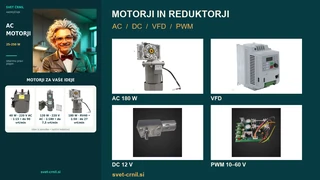
- AC motor 40 W, 220 V, reduction factor 1:15, up to 90 rpm
- AC engine 120 W, 220 V, reduction factor 1:180, up to 7,5 rpm
- AC engine 180 W with reducer RV40, 1:50, up to 27 rpm
- Frequency converter VFD 1,5 kW, input 230 V
- DC engine with reducer, 12 V / 55 rpm
- DC engine with reducer, 12 V / 20 rpm
- DC engine with reducer, 12 V / 3 r/min
- DC engine with reducer, 24 V / 200 rpm
- Universal speed regulator DC engine, 10-60 V, up to 20 A
The photos are from the actual offer Svet Črnil. The connection to the AC set with the dedicated regulator does not confirm compatibility with the displayed VFD. For 120 W the product side sets out the useful range 5–7,5 garden/min. Before selecting the VFD we also check its output phases and compatibility with the specific engine.
How do we help you choose?
Tell us what you want to move, what speed should be and what load it is. The available power supply, operating time, installation space and photo of the nominal plate of the existing engine are still useful. This allows us to choose the engine, reducer and regulator as a harmonised assembly.
Andreystein and the speech are prepared with the help of artificial intelligence. Photos of products originated from the website Svet Črnil; animation of the mechanisms are teaching illustrations.
Frequently Asked Questions
AC and DC engines, VFD and regulators: Frequently Asked Questions