Video
Watch in English
Andrejstajn: AC and DC gearmotors and VFDs
Choosing a motor, gearbox and speed controller
Andrejštajn introduces AC and DC gearmotors and explains what a variable frequency drive can do. The presentation covers our industrial 220 V motor programme from 25 to 250 W. Select the actual model using its specifications, nameplate and instructions. Matching supply voltage alone does not establish compatibility with a speed controller.
What do AC and DC mean?
AC means alternating current: supply voltage changes polarity periodically, and frequency is part of the motor specification. DC means direct current. Small brushed DC motors can be convenient for battery-powered mechanisms, compact machines and prototypes. Brushless DC motors and stepper motors require suitable dedicated electronics; a brushed DC controller is not a universal substitute.
What does a gearbox do?
A reduction gearbox lowers output speed and increases available torque, allowing for transmission losses. It does not create extra power. For a conveyor, mixer or rotary mechanism, determine the desired speed, continuous and starting torque, duty cycle, and permitted radial and axial shaft loads. A worm gearbox must not be assumed to provide a safety brake for a suspended load.
How does a VFD work?
A variable frequency drive first rectifies incoming AC into a DC intermediate circuit. Its inverter then produces controlled AC with adjustable frequency and voltage. A compatible motor can therefore run at a chosen speed with a defined acceleration or deceleration ramp. The usable range depends on the motor, drive and load. ABB explains the conversion process.
Conveyor example: 50 Hz and 25 Hz
For the same induction motor and unchanged gearbox, reducing frequency from 50 Hz to 25 Hz gives approximately half the speed. Actual speed also depends on motor slip and load. A slower conveyor can make filling, weighing or packing easier, while an acceleration ramp reduces abrupt starting. The animation is an explanation of the principle, not a measured test of a particular motor-and-drive combination.
What happens at low speed?
A VFD does not increase the motor’s rated power. Check allowable continuous torque, current and cooling at low speed. A shaft-driven fan may provide less cooling as the motor slows, so sustained loaded operation needs a verified operating range. For demanding slow movement, choose a suitable reduction ratio as well as a compatible control system.
Why does a compatible three-phase motor need no extra motor capacitor?
In a suitable combination of a 230 V single-phase-input, 230 V three-phase-output VFD and a compatible three-phase motor, the drive supplies all three phases. The motor does not need the additional start or run capacitor used by certain single-phase motors to create a phase shift. The VFD itself may still contain DC-link capacitors. Schneider Electric gives an example of this arrangement.
Can I simply remove a capacitor from any 220 V motor?
No. A single-phase capacitor motor is a different motor type. A standard three-phase-output VFD is not a general replacement for its capacitor or its dedicated controller. Check phase count, winding voltage, connection arrangement, rated current and the manufacturers’ instructions. Special drives for specified single-phase motor types do exist, and their prescribed wiring must be followed. Oriental Motor explains compatibility; an example of a specialised single-phase drive.
Where are DC gearmotors convenient?
Brushed DC gearmotors can simplify small machines, robots, powered movements and battery-powered devices. Choose the correct DC voltage and required output speed. A PWM controller rapidly switches the supply; changing the on-time duty cycle changes the average motor voltage and influences speed. Load also affects the resulting speed. STMicroelectronics describes brushed DC control.
The 10–60 V, up-to-20 A DC speed controller
This controller is intended for compatible brushed DC motors and a DC supply within its 10–60 V operating range. The supply must also match the motor’s rating. Check starting current, continuous load, cooling, wiring and protection; the up-to-20 A rating alone does not confirm suitability. This unit does not turn an arbitrary source into the required supply voltage, and it is not a BLDC or stepper driver.
Products shown in the presentation
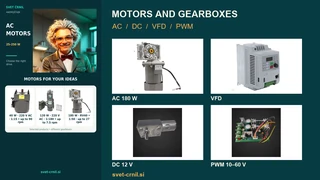
- 40 W, 220 V AC gearmotor, 1:15, up to 90 rpm
- 120 W, 220 V AC gearmotor, 1:180, up to 7.5 rpm
- 180 W AC motor with RV40 gearbox, 1:50, up to 27 rpm
- 1.5 kW VFD, 230 V input
- DC gearmotor, 12 V / 55 rpm
- DC gearmotor, 12 V / 20 rpm
- DC gearmotor, 12 V / 3 rpm
- DC gearmotor, 24 V / 200 rpm
- DC motor speed controller, 10–60 V, up to 20 A
Product photographs come from the actual Svet Črnil catalogue. An AC motor kit with a dedicated controller is not thereby confirmed compatible with the pictured VFD. The 120 W kit’s product page specifies a useful operating range of 5–7.5 rpm. Verify the VFD’s output phase configuration and its suitability for the selected motor before choosing a combination.
Tell us what your mechanism needs
Tell us what you want to move, the required speed and the load. Include the available power supply, operating time, installation space and a nameplate photo if you already have a motor. These details help us select a matched motor, gearbox and controller.
Andrejštajn and the narration were created using artificial intelligence. Product photographs come from the Svet Črnil website; mechanism animations illustrate operating principles.